Overview
Heliophysics is the science of how the Sun interacts with everything around it: planets, moons, comets, dust, magnetic fields, and even the invisible edges of our solar system.
It connects astronomy, plasma physics, planetary science, and space weather into one big story: how the Sun shapes our cosmic neighbourhood.
This page introduces the core ideas behind heliophysics and sets the stage for the entire Helio House.
What is Heliophysics?
Heliophysics is the study of the Sun as a star and its influence throughout the solar system.
It brings together:
> Solar physics (the Sun’s behaviour and structure)
> Space weather (flares, solar wind, storms, radiation)
> Planetary science (how planets respond to the Sun)
> Astrophysics (using the Sun as a model for other stars)
> Plasma physics (the behaviour of charged particles and magnetic fields)
It answers questions like:
🌟 How does the Sun create space weather?
🌟 How does that weather reach Earth and the planets?
🌟 How does the heliosphere protect us from interstellar space?
Heliophysics is everything between the Sun’s core and the very edge of the solar system.
The Heliosphere
A giant, invisible bubble powered by the Sun
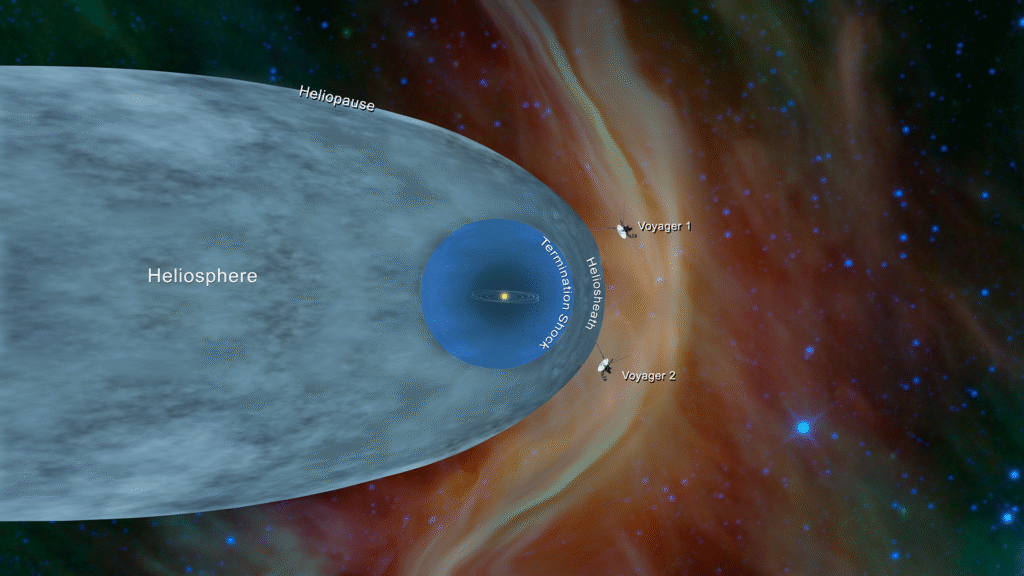
The heliosphere is the enormous bubble of space carved out by the Sun’s constant outflow of plasma (the solar wind). It expands far beyond the planets, stretching more than 100 times farther than the distance from the Earth to the Sun. Everything inside this bubble, from Mercury to the edge where Voyager 1 drifts, is living inside the Sun’s influence.
The Solar Wind: The Bubble-Maker
The Sun is always blowing a stream of electrically charged particles in all directions. This solar wind is:
> Fast (can reach over 800 km/s) *
> Hot (millions of degrees in the corona) *
> Magnetised (it drags the Sun’s magnetic field with it, shaping space)
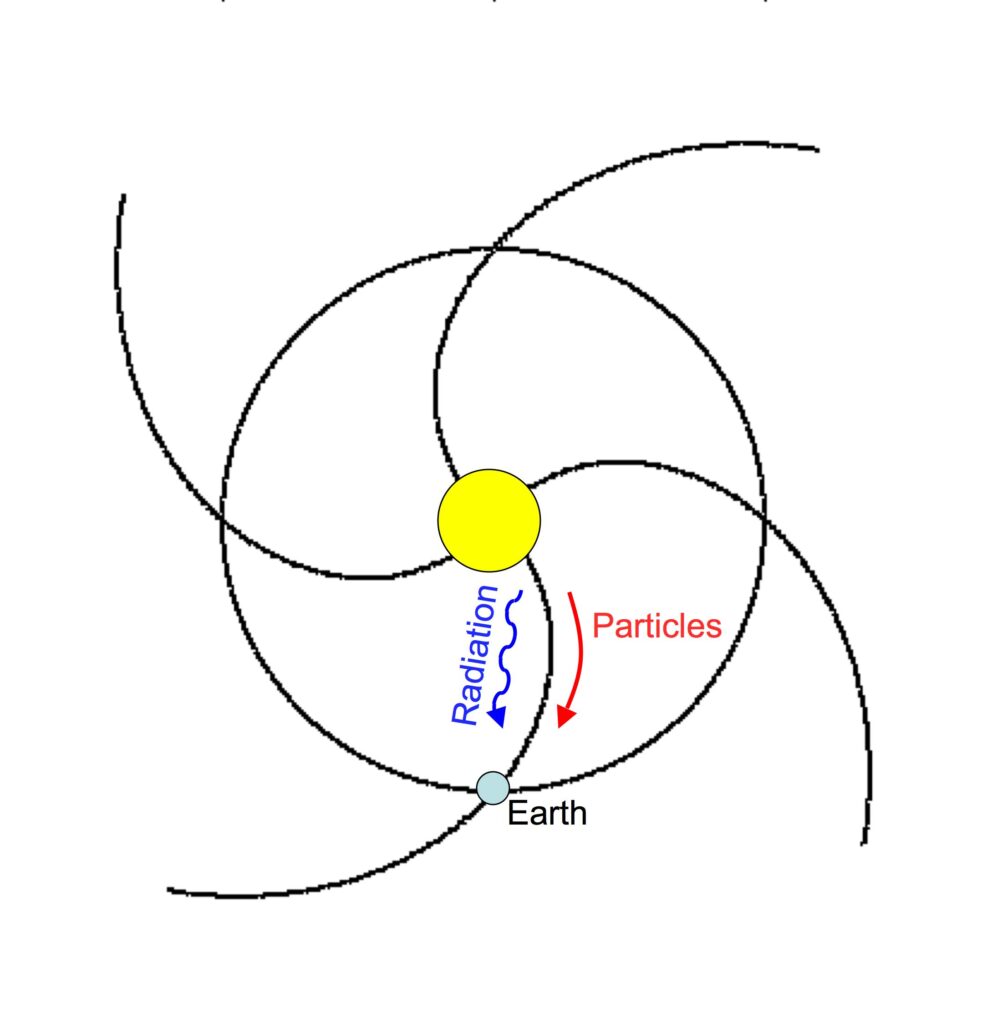
Because the Sun rotates, this outward flow forms the famous Parker spiral, twisting the heliosphere into a giant, spiralling magnetic structure.
* Scientists talk about “fast” and “slow” solar wind, but both are still incredibly fast by everyday standards. The “slow” wind is still travelling at hundreds of kilometres per second. Likewise, when we say the solar wind is “hot,” we mean its temperature is extremely high, not that it carries a lot of heat. It’s like putting your hand in a hot oven versus boiling water: the oven has a higher temperature, but the water transfers heat far more efficiently. The solar wind is similar, a very high temperature, but so thin that it barely transfers heat at all.
The Heliospheric Current Sheet (HCS): The Solar System’s “wavy sheet”
Running through the middle of the heliosphere is the HCS, sometimes called the “ballerina skirt.”
It is the boundary between opposite magnetic polarities in the solar wind – and it is massive, wrinkling and waving through the whole solar system.
As the Sun’s magnetic field flips every ~11 years, the HCS stretches, tilts, and becomes more wobbly. Spacecraft crossing it feel rapid magnetic changes, and energetic particles can drift along its surface like a cosmic highway.
Where the Heliosphere Ends
The heliosphere isn’t infinite, eventually it weakens enough that interstellar space pushes back. It ends in three major regions:
🌟 Termination Shock:
Where the fast solar wind suddenly slows down as it plows into the interstellar medium. Voyager 1 and 2 detected this shock years apart, giving us our first real “edge map.”
🌟 Heliosheath:
A turbulent region beyond the shock where slowed-down solar wind piles up. It’s a bit like the water building up in front of a boat.
🌟 Heliopause:
The true outer boundary, where the solar wind loses its battle with interstellar space. This is where the Sun’s influence ends, and the galaxy’s begins.
Voyager 1 crossed it in 2012, and Voyager 2 followed in 2018. Both spacecraft are now officially in interstellar space, still sending signals home.
Why the heliosphere matters
The heliosphere acts as a cosmic shield, blocking a huge amount of high energy galactic cosmic rays from reaching the inner planets. Without it:
> Earth’s radiation levels would rise dramatically
> Spacecraft electronics would be damaged far more often
> Astronaut travel would be much riskier
> Planetary atmospheres and surfaces would be exposed to harsher interstellar radiation
In other words: the heliosphere is one of the biggest reasons our solar system is safe and habitable.
A living, breathing bubble
The heliosphere is not static, it expands when the Sun is active and shrinks when the Sun is quiet.
> During solar maximum, stronger solar wind inflates the bubble outward.
> During solar minimum, weaker wind lets interstellar space push in slightly.
CMEs and fast solar wind streams create temporary dents, waves, and distortions. It is a dynamic system responding to every change on the Sun, from sunspot cycles to solar storms.
Plasma Physics in space
The science of charged particles, magnetic fields, and the invisible forces that shape our solar system
When you think of matter, you probably picture solids, liquids, and gases.
But in space, the most common state of matter by far is plasma: a hot, electrically charged soup of particles that behaves in ways no normal gas does. The Sun, the solar wind, auroras, lightning, and even neon signs… all plasma. Understanding plasma is key to understanding how the Sun affects everything around it.
What exactly is plasma?
Plasma forms when a gas becomes so hot that its atoms break apart into:
> Electrons (negative charge)
> Ions (positively charged atoms)
This makes plasma electrically active. Because it’s full of moving charges, it can carry currents, generate magnetic fields, and respond to electromagnetic forces. Unlike a gas, plasma is shaped by magnetism as much as pressure or motion.
The interactions of magnetic fields and plasma
In plasma, magnetic fields behave almost like they are “frozen” into the material. When plasma moves, the magnetic field gets dragged along with it. This leads to some of the most important space phenomena:
🌟 Magnetic loops on the Sun
🌟 The Parker spiral in the solar wind
🌟 The heliospheric current sheet
🌟 Magnetospheres around planets
🌟 Auroras
🌟 Space storms and radiation belts
Plasma + magnetic fields = the entire field of magnetohydrodynamics (MHD). But don’t worry, we’re not doing equations here.
Plasma waves: Yes, space has waves
Even though space is (mostly) empty, plasma can create waves just like the ocean:
> Some waves shake magnetic field lines
> Some compress the plasma
> Some carry energy across millions of kilometres
> Some can accelerate particles to near light speed
These waves play a role in the aurora, in radiation belts, and even in how solar storms travel.
Shocks and Turbulence: Space Weather in action
When fast solar wind slams into slower wind, or when a CME blasts outward at high speed, shocks form (similar to sonic booms from an airplane). These shocks can:
> Heat plasma to incredible temperatures
> Scatter particles
> Accelerate protons and electrons to dangerous energies
> Create storm conditions around planets and spacecraft
Between shocks, the solar wind is full of turbulence, constantly swirling and mixing, like currents in a river.
Where We See Plasma in Action
Plasma physics explains almost everything dynamic in the solar system:
🌟 Solar flares: magnetic energy suddenly releasing
🌟 Coronal mass ejections: plasma clouds launched into space
🌟 Auroras: energetic particles spiralling along magnetic field lines towards our atmosphere
🌟 Planetary magnetospheres: plasma deflecting solar wind
🌟 Radiation belts: trapped energetic particles
🌟 Comet tails: solar wind interacting with comet plasma
🌟 Shocks around planets and CMEs
🌟 The heliosphere itself
Once you know plasma physics, you see the universe differently, everything becomes interconnected.
Solar–Planetary interactions
Even though all planets share the same star, the way they respond to the Sun’s energy, particles, and magnetic fields varies dramatically. Some worlds glow with auroras, some get blasted by the solar wind, some lose their atmospheres, and others channel energy into gigantic storms.
Earth: Protected but reactive
Earth has a strong magnetic field and a thick atmosphere, giving it one of the most complex Sun–planet relationships.
> The magnetic field deflects most solar wind
> Charged particles spiral toward the poles → auroras
> Strong solar storms can disturb GPS, radio, satellites, and power grids
> The atmosphere absorbs harmful UV and X-ray radiation
Earth is shielded, but not immune.
Mars: A planet that lost its shield
Mars used to have a strong magnetic field, but it faded billions of years ago. Without that protection:
> The solar wind directly erodes the atmosphere
> Mars is constantly losing gas to space
> Solar storms can strip even more material during strong events
> Auroras still occur, but they spread across the whole sky, not just the poles
Mars is a great example of how the Sun can reshape a planet over time.
Mercury: Fully exposed
Being so close to the Sun, Mercury experiences:
> Intense solar wind
> Constant particle bombardment
> Extreme space weather conditions
It does have a weak magnetic field, but it’s tiny, so space weather often hits the surface directly, knocking particles off and creating a thin, temporary “exosphere.”
Jupiter: A magnetosphere the size of a star
Jupiter has the largest magnetic field of any planet. This creates:
> Auroras hundreds of times more energetic than Earth’s
> Particle storms that would fry a spacecraft in minutes
> Enormous radiation belts
> A constantly roaring, swirling plasma environment
Jupiter interacts with the Sun, but it also generates a lot of its own space weather internally.
Saturn: Gentle giant with dynamic rings
Saturn’s magnetic field is weaker than Jupiter’s but still strong enough to:
> Create UV auroras
> Trap plasma in the rings
> Interact with the solar wind in seasonal patterns
During solar storms, its rings brighten as energetic particles slam into the ice.
Moons and Other Bodies
The Moon
No atmosphere. No magnetic field. When solar wind hits it, particles embed in the soil. Dust can even become electrically charged and lift off the surface.
Europa, Ganymede, Callisto
Jupiter’s moons sit inside its mass of plasma. Ganymede even has its own magnetic field, the only moon that does!
Comets
When they approach the Sun, they develop two tails:
> A dust tail (sunlight pressure)
> A plasma tail (solar wind interactions)
Venus
Thick atmosphere but no global magnetic field → the Sun sculpts its upper atmosphere directly, creating comet-like “tails” streaming out behind it.
Why these interactions matter
Understanding how the Sun affects different worlds helps us:
> Study planetary atmospheres
> Protect spacecraft from radiation
> Choose safe astronaut travel routes
> Compare Earth to other planets
> Understand how solar systems evolve
It also helps us predict how the Sun might affect Earth in the future, especially during solar maximums, flares, and extreme events.
The Big Picture: A Connected System
Heliophysics is not just about the Sun, or the planets, or space weather, it’s about how every part of the solar system reacts to every other part. Imagine the entire solar system as a giant living machine, with the Sun at its heart. When the Sun changes, everything else responds.
Solar flares → solar wind → magnetospheres → atmospheres → surfaces → technology → humans.
(1) Everything starts in the Sun’s core
Deep inside the Sun, nuclear fusion creates:
> Light
> Heat
> Magnetic fields
> A constant flow of energy outward
(2) From Sunspots to Solar Storms
The Sun’s magnetic field is constantly twisting, tangling, and re-shaping itself.
This leads to:
> Sunspots
> Solar flares
> Coronal mass ejections (CMEs)
> High-speed solar wind streams
When the magnetic field snaps and reconnects, huge amounts of energy are released, launching storms that travel through the solar system.
(3) Radiation and Particles Spread Outward
Energetic particles and solar wind flow across the heliosphere, following the curved paths of the Parker spiral.
Along the way, they:
> Interact with planetary magnetic fields
> Create auroras
> Build radiation belts
> Heat atmospheres
> Cause storms in space
> Change the shape of magnetospheres
(4) Planetary Responses: Each world is different
Every planet (and many moons) respond depending on:
> Their magnetic fields
> Their atmospheres
> Their distance from the Sun
> Their size, rotation, and internal structure
Earth protects us. Mars gets stripped. Jupiter glows fiercely. Mercury gets blasted head on. This diversity helps scientists understand not just our solar system, but how stars shape planets everywhere.
(5) The Heliosphere: Our protective bubble
All solar wind and magnetic activity inflate the heliosphere, our enormous solar bubble. It shields us from interstellar radiation and marks the boundary between “our Sun’s space” and the wider galaxy. Changes on the Sun ripple outward to the heliopause itself.
The Feedback Loop: Space Weather meets technology
The Sun’s influence reaches all the way to Earth’s surface, often through the technology we rely on:
> GPS signals can be disrupted
> Radio blackouts can disrupt communication
> Satellites can become charged or damaged
> Astronauts face radiation hazards
> Power grids can feel geomagnetic currents
> This is why heliophysics is both a space science and a practical science.
Why Heliophysics Matters
Heliophysics helps us answer big questions:
🌟 What controls space weather?
🌟 How do stars shape their planets?
🌟 What makes a planet habitable?
🌟 How do we protect astronauts and spacecraft?
🌟 What can our Sun teach us about stars everywhere?
It connects the microscopic (particles) and the cosmic (the heliosphere). It links physics, astronomy, geology, engineering, and even climate science. Most importantly, heliophysics gives us the tools to understand, and live safely within, our dynamic solar system.